
A FARMACIST’S PRESCRIPTION~THANKS TO THE MAN I NEVER MET, BUT CAME TO KNOW
REFLECTIONS ON THE LIFE AND INFLUENCE OF WENDELL BERRY
A renowned author, poet, farmer, environmental activist and so much more has influenced my farming, my thinking, and my writing more than anybody else, died on the last day of August. Wendell Berry is his name and I never met him. I never heard his actual voice except through recordings. I never shook his hand, sat across a table from him, or had the chance to ask him about farming, faith, writing, life, pigs, or any of those thousand ordinary things that become extraordinary when a person pays close enough attention to them. And yet, in some strange and wonderful way, Wendell Berry became one of my teachers. He died at his home in Port Royal, Kentucky, at the age of 92, and today I find myself thankful for a man I never knew personally but somehow he seemed to know a great deal about the life I was trying to find my way toward.
In the summer of 2025, Tammy and I, along with two good friends, Tish and Buck, gave meeting Wendell Berry the old college try. We made our way to Kentucky and eventually found the township of Port Royal. We knew better than to expect Wendell Berry to be sitting on the porch at ninety years of age waiting for two Texans and two Okies to show up wanting to talk farming and theology.
Wendell spent much of his life resisting the machinery that turns writers into celebrities and human beings into brands, which is probably one of the reasons we liked him in the first place. He was attractively odd. And Buck had written him a letter earlier in the year complimenting one of his essays and Wendell wrote him back. So we had a smidgen of hope to get a glimpse as we moseyed up to the Berry Center thinking providence might arrange an introduction. It didn’t. Wendell Berry wasn’t there.
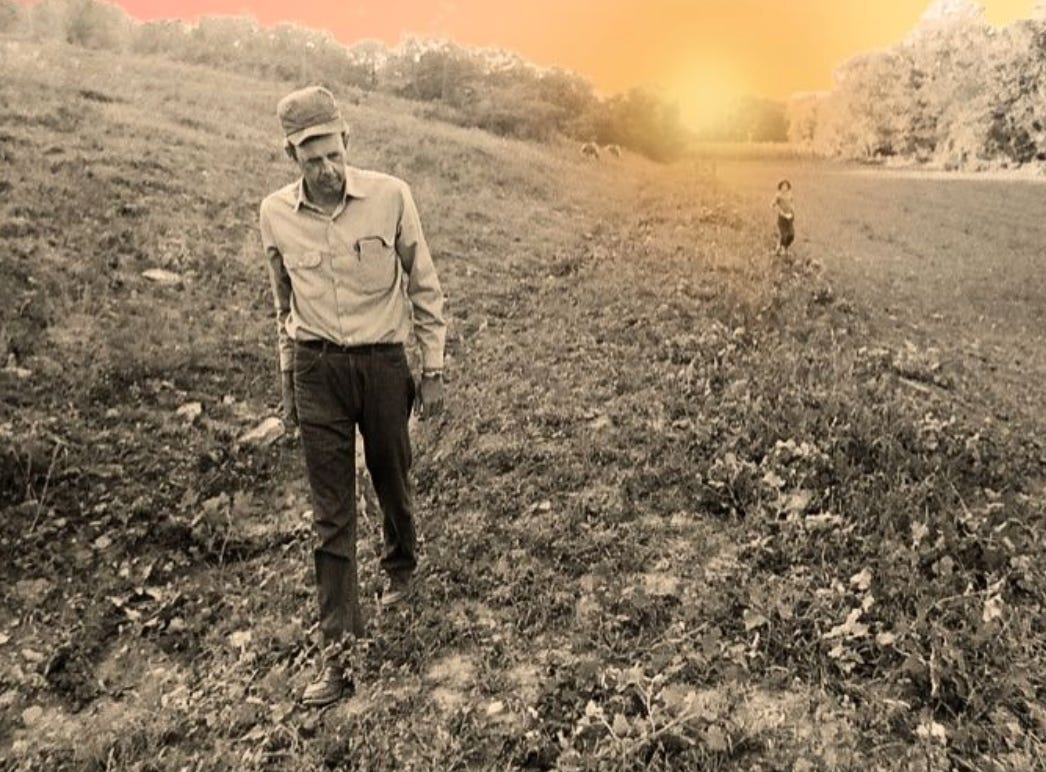
We had come for more than that though. I wanted to see the place. I wanted to stand near the tobacco fields, roads, river, barns, fences, houses, and people that had given him something worth paying attention to for all those years. I wanted to see the animals, woods and country where the words came from before they found their way onto paper.
Berry famously resisted computers and did his writing by hand, and there seems to me something fitting about that. His words passed first through a human hand, but before they came through the hand, they came through a place. We didn’t meet Wendell Berry that day, but perhaps we received something else. We came home understanding a little better why his writing had mattered so much to us—and especially to me.
There will be much written about Wendell Berry in days, and weeks to come. His poems will be quoted, his novels remembered, and his essays pulled from bookshelves. A lot of us will probably underline again the sentences we underlined twenty years ago. But today I don’t particularly want to write about what Wendell Berry wrote. I want to write about what Wendell Berry taught me, and the first thing he taught me was how to see and experience a farm.
I didn’t begin farming because I wanted to become like Wendell Berry. The world didn’t need another Wendell Berry, and it surely didn’t need an East Texas reared United Methodist preacher pretending to be one. But the more I farm, the more I understand what he spent a lifetime trying to tell us: a farm is not a factory. A farm is a living community of soil and water, grass and trees, rain and drought, animals and people, work and waiting, failure and hope, memory and possibility, food and family and neighbors. And, if we are paying attention, a farm is one of those places where God keeps preaching sermons without ever opening a Bible.
That’s the kind of place I want Stillwater Farm to be. I don’t want a farm scrubbed clean of everything except the one thing we happen to be selling. I want pigs rooting beneath the trees and sheep grazing what the pigs leave behind. I want cattle moving across the pasture at their own slow, plodding cadence, staying long enough to graze but not so long that they come to believe the whole field belongs to them. I want chickens and guineas and ducks and geese making more noise than any respectable farm probably ought to tolerate. I want to be awakened by a rooster crowing. I want pecan trees and oak trees dropping their hard shell covered nut. I want fences that occasionally need mending, gates somebody from time to time forgets to latch, and animals that periodically remind the farmer that most of his carefully constructed plans are really only suggestions.
I want the farm alive. Berry helped me understand that diversity isn’t necessarily inefficiency. Sometimes diversity is precisely what allows a farm, a community, or perhaps even a church to endure. It is resilience wearing boots covered with what looks like mud. Berry also helped give depth to a word that had been working its way into my own thinking for some time: homeplacing. He didn’t speak or write the word but he inspired it. I used that word in my book Farewell ~ Tending to a Soul, but I know I understand it better today than when I first wrote the book. A homeplace isn’t simply the place where you happen to live. It is the place to which you have learned to belong, and belonging is a very different thing from possessing. You come to know a place well enough to love it, and then, if the love is genuine, you begin accepting responsibility for it.
That’s when your questions begin to change. Instead of always asking, “What can I get out of this land?” you begin asking, “What does this place need from me?” That’s a considerably more troublesome question because it changes how you treat the soil and water, how you treat an animal, what you decide not to spray, how you hope something grow quickly, and how you think about the neighbor next door. You encourage your neighbors bees to feast on your clover and look forward to a jar of honey from a kind of sacred partnership.
It even changes how you think about children who aren’t yet old enough or focused enough to know that one day they will inherit the consequences of decisions you are making right now. Eventually it changes what you mean when you say, “This is my farm.” I’m not sure that’s quite right anymore. Maybe the more truthful sentence is, “I’ve been entrusted with this place for a little while.” I didn’t make this land. I didn’t cause the rain to fall. I didn’t put the life into a seed or teach a sow how to make a nest before her piglets arrive. I showed up somewhere in the middle of a story that began before me and, God willing, will continue after me. I get a turn. No one said that or lived it better than Wendell.
For more than forty years I wrote sermons, week after week, year after year. I spent most of my adult life thinking about the well being of souls—about faith and grace, forgiveness and sin, community and loneliness, suffering and hope, death and resurrection, and the strange mystery of what it means to be a human being standing before God. Then I retired and got serious about my next on the family farm. Some people might consider that a change of vocation, but I’m beginning to think it wasn’t much of a change at all. I simply changed pulpits.
These days I listen to more sermons that I preach. Some of my favorite sermons that I hear these days are preached by pigs. Some are preached by pecan trees or a seed dropped down into East Texas sandy soil. Rain coming after you’ve nearly given up on it can preach a pretty good sermon about grace. I need a rooster to crow at day break outside my window taking responsibility for the call to worship without consulting me or anybody else. Wendell helped me understand that these things aren’t interruptions of the spiritual life. They are part of it. We sometimes spend our lives searching for God in the extraordinary while walking right past a thousand ordinary things in which grace has been patiently waiting for us to notice.
A loaf of bread carefully made by a Tish, a garden yielding its fruit free for the picking that Buck has cultivated. Then there’s a barn, a pasture, a meal shared with friends, a family gathered around a table, a farmer walking the same fence line he walked yesterday, or an animal giving its life so another family can eat—and eat well coming to know that nutrition has a delicious flavor. These are not insignificant things. They aren’t sacred because they are rare. They are sacred precisely because they are ordinary, and ordinary life is where most of God’s gifts are actually given.
Wendell knew that and believed in the ordinary enough not to be caught up in the pull of the city that says, “All writers must come to live and write in New York City if you want to be noticed.” He wasn’t going to do that. He didn’t care so much about being noticed as he did noticing what God was doing on the farm and writing about it. He was going to write all of his life from a place that few completely understood and hardly anyone fully appreciated. It just didn’t matter to him.
Wendell Berry changed the way I write too. After forty-three years of writing sermons, I wondered what in the world I would find to write about when retirement came. Not that Jesus is not a good subject, but the Creator occupies our space as well as the Holy Spirit inspires the words and all whisper in my ear at the farm. It turns out the stories hadn’t disappeared; they had simply wandered out of the sanctuary and into the pasture. A pig rooting beneath an oak tree can inspire a story. A sunrise over Stillwater Farm can tell a tale as well. A livestock trailer headed down the highway with Iberico pigs can tell one. A pig found dead beneath a gate can preach a hard little sermon about mortality. A jar of pickles can tell a story about abundance and generosity. And a meal prepared from what was raised nearby can tell a story about neighbors and community.
I still believe deeply in tending to souls. I’ve simply come to believe that sometimes one of the best ways to tend to a soul is to pull out a chair, set somebody at the table, and give them something good to eat. Sometimes grace arrives in a sermon, and sometimes it comes in a bowl of beans, a slice of good cornbread, some pork from a platter, a jar of something put up last summer, and enough time around the table to listen to one another. That’s the way Wendell taught soul-tending.
Perhaps Wendell’s greatest influence on me now, however, is that he taught me to think beyond myself. The modern world keeps asking us: How much can we produce? How fast can we produce it? How much can we sell? How much money can we make? How much can we get? Wendell kept turning our attention toward another question: What kind of place will remain when we are finished getting what we want?
That question matters more to me now than it did when I was thirty or forty. Stillwater Farm has been in our family for six generations, and when I walk those acres I know I am not walking alone. Somewhere behind my shoulder are great-grandparents, grandparents, parents, aunts and uncles, and people who dug holes and planted trees knowing perfectly well they might never sit beneath their full-grown shade. Somewhere ahead of me are my children, my grandchildren, perhaps their children and grandchildren, and people whose names I will never know but who may someday walk the same ground.
So I don’t want to farm merely for this season. I want my grandchildren to know what it feels like to walk across a pasture and recognize the animals and call them by name. I want them to understand that food doesn’t begin in a grocery store and that dirt beneath your fingernails isn’t necessarily evidence that something has gone wrong. Sometimes it means something has gone exactly right. I want them to know the satisfaction of work that leaves you tired enough to sleep, to understand that animals deserve respect even when they are being raised for food, and to eat pears from trees planted by people they never knew. Most of all, I want them to inherit soil that is healthier because I had my turn with it.
That may be one of the greatest gifts Wendell Berry gave me: the conviction that a good life ought to leave some goodness behind. A farm ought to be better because a farmer tended it. A community ought to be stronger because a person lived there. A family ought to carry a little more grace because somebody loved them first. A church ought to be more faithful because a pastor served there and cared for people in their times of need. A nd when our turn is over, perhaps the best testimony to our living is that somebody who comes after us finds something worth tending.
So, Wendell, I suppose this is my thank-you note to you, a man I never met. Thank you for putting words around things I had begun to feel but didn’t always know how to speak it. Thank you for reminding us that land is more than real estate, that food is more than a commodity, that farming is more than production, and that work done well can become a form of prayer. Thank you for reminding us that community requires neighbors, that limits aren’t necessarily enemies, that bigger isn’t always better, and that faster isn’t always progress. Thank you for helping me see that a table can become something like an altar and that home is something we tend, not merely somewhere we sleep at night. I think I’ll take a page out of my friend, Buck’s playbook and write Wendell a letter.
Dear Wendell, I wish I could have sat across from you. I wish I could have heard your voice in the room. I wish I could have asked you about farming and faith and writing and what you learned by staying put long enough to know a place. But perhaps, in another way, we did have that conversation. I read your books. I have been on some of your backroads. I saw the river. I stood in the country that made its way into your words. And then I came home to my own homeplace with a thankful and greatly inspired heart.
This morning at Stillwater Farm, the animals were waiting. They hadn’t heard the news. The pigs were rooting, the cattle are grazing, and old Charlie Brown the donkey is hee-hawing his heart out like he does every day. Grass was growing where it could. The trees stood where they stood yesterday. The farm was doing what farms have always done, reminding me that life continues whether or not any one of us is here to supervise it. There is sadness in that, but there is mercy in it too.
Wendell I’ll keep farming, and I’ll keep writing, and I’ll keep preaching, though these days my sanctuary has fewer pews and considerably more manure. I’ll keep trying to tend this little patch of East Texas earth that has been handed to me, and I’ll keep trying to practice one of the truths you spent your time helping many of us understand: to love a place is to accept responsibility for it.
Maybe that’s what homeplacing really is. Maybe that’s what stewardship is. Maybe, when we get all of our church words out of the way, that’s one of the simplest descriptions of faithfulness I know. We love something we didn’t create. We care for something we cannot keep. We receive what somebody before us tended, and we leave something for somebody who will come after us. For one brief season somewhere between those who came before and those still on their way, we get a turn.
Rest well, Wendell. We never met, but I want you to somehow know that you taught me. You changed the way I farm, the way I write, the way I live, and the way I understand home. And today, as I walk this East Texas ground and listen to the farm carrying on without either one of us being particularly necessary to it, I find myself grateful that you spent your turn helping the rest of us learn how to better tend ours.
RX: Pick up a Wendell Berry book, or get one read to you and let it sink in deep. My first of his novels was Jayber Crow. I’m reading The Way of Ignorance now. Whatever you choose, rest in the poetic movement of his words.